 George Webb
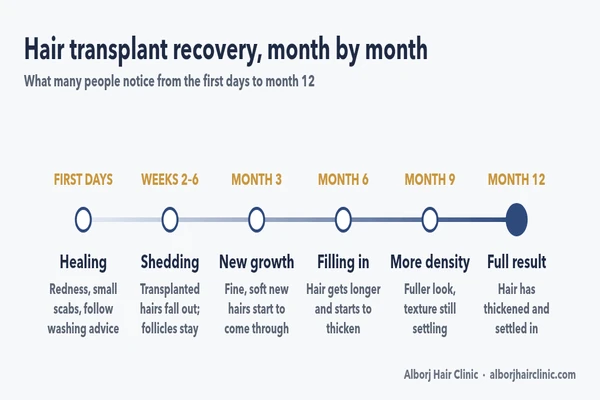
Recovery from a hair transplant happens in slow, predictable stages. The scalp heals over the first week or two, and the transplanted hairs often shed in the weeks that follow. New hair usually appears at around three months, fills in by around six, and reaches its full result at around 12 months.
This guide explains what is normal at each stage, what helps, and how to track your progress without checking the mirror every morning.
What happens in the first days after a hair transplant?
The first days are about letting the scalp settle. Some redness, small scabs around each graft and mild swelling are common. The swelling can spread down to the forehead before it fades.
With DHI (Direct Hair Implantation), follicles are removed one by one with fine punches and placed with an implanter pen. That means there are no stitches to look after, only small openings that heal on their own.
Washing matters most in this phase. Your clinic will explain when to start, how to do it and how to dry the area. Follow those instructions exactly, even if advice online says something different.
- Leave the scabs alone. Picking or scratching can disturb the grafts, and the scabs come away with gentle washing.
- Rest with your head raised. Many clinics advise this for the first few nights to help reduce swelling.
- Avoid pressure on the grafts. Tight hats and helmets can rub, so ask your surgeon when a loose hat is fine.
Many clinics advise taking a few days away from work, longer if your job is physical. Your own surgeon’s instructions on work, sun and exercise always come first.
What does your scalp look like at one month?
By the end of the first month, the redness has usually faded, but much of the transplanted hair may have fallen out. This shedding often happens between weeks two and six, and it is expected.
Shedding is not a sign that the procedure has failed. The hair shaft falls away, while the follicle stays in place under the skin and rests before it grows a new hair.
Some people also notice that their existing hair nearby looks a little thinner for a while. If you are unsure whether what you see is normal, ask your clinic rather than guessing.
Emotionally, this can be the hardest month. Your scalp may look much as it did before surgery, which is why knowing the timeline in advance helps so much.
What changes at three months?
Around the three-month mark, new growth usually begins. The first hairs tend to be fine and soft, and some areas may come through ahead of others.
A few small spots, a bit like ingrown hairs, can appear as new hairs push through the skin. These usually settle by themselves, but mention anything sore or lasting to your clinic.
At this point, the change in your appearance is still small. What matters is that growth has begun, which shows the follicles have settled.
“Month three is when most patients relax, because they can finally see new hairs coming through. I still ask them to judge the result at a year, not before. Hair grows slowly, and the follicles need that time.”
How much has filled in by six and nine months?
By around six months, most people see a clear difference. The hair is filling in, getting longer and starting to thicken, and many people begin styling it again.
The texture may still differ from the rest of your hair. New hairs can come through finer, wavier or coarser at first, and this often evens out as they mature.
By around nine months, the hair has usually gained more length and density. Many people feel it now looks natural in everyday life, although it is not yet the finished picture.
What does the result look like at 12 months?
The full result usually shows at around 12 months. By then, the transplanted hair has grown in, thickened and settled into its natural texture.
Once established, transplanted follicles normally keep growing for life. The original hair around them can still thin with age, which is why a careful surgeon plans the design with the future in mind.
If your clinic offers a review at this stage, use it. It is a good moment to talk about how the result has settled and what to look out for in the years ahead.
How can you track your progress without worrying?
Daily mirror checks are a poor guide, because the changes are too slow to notice from one day to the next. Photos taken at set intervals give a far clearer picture.
- Take a set of photos before the procedure, from the front, top, both sides and back.
- Repeat them once a month in the same spot, with the same lighting and the same angles.
- Keep your hair dry and styled the same way each time, so you compare like with like.
- Look at the photos month against month, not day against day.
If growth seems slower than expected, speak to your clinic. Some people simply grow at a slower pace, and the surgeon can check the area in person.
About Alborj Hair Clinic
Alborj Hair Clinic is a hair transplant clinic in Mazaya Centre, Al Wasl, Dubai. Its surgeon, Dr Dimitrios Ziakas, has 24 years of experience and has performed more than 4,000 hair transplant procedures. He is a member of the International Society of Hair Restoration Surgery (ISHRS) and uses the DHI (Direct Hair Implantation) technique.
Before-and-after case studies on the clinic’s website give a sense of what a finished result can look like.
Frequently asked questions
Is it normal for transplanted hair to fall out?
Yes. Shedding in the first few weeks is common and expected. The follicles stay under the skin and usually start producing new hair at around three months.
When can I wash my hair normally again?
Your clinic will give you a washing routine for the first days and tell you when to return to your usual one. Gentle, careful washing helps the scabs come away without disturbing the grafts.
Can I fly soon after a hair transplant?
Many clinics advise waiting a few days before flying, so the first stage of healing is under way. Check with your own surgeon before you book a return flight.
Why does my hair still look thin at six months?
At six months, many new hairs are still lengthening and thickening. The full result usually shows at around 12 months, so it is worth waiting before you judge it.